Sad Desk Salad by Jessica Grose
Publisher: William Morrow Paperbacks
Release Date: October 2, 2012
My rating: 4 of 5 stars
Publisher’s Description:
As a writer for Chick Habit, an increasingly popular women’s website, Alex Lyons gets paid to be a bitch. She’s churning out several posts a day, and she saves her juiciest ones for blog prime time, when working women eat their sad desk salads in their offices. Alex tells herself she’s fulfilling her dream of being a professional writer; so what if it means being glued to her couch and her laptop from six a.m. to six p.m., scouring the web in search of the next big celebrity scandal? Since Chick Habit’s parent company keeps close tabs on page views, Alex knows her job is always at risk.
So when an anonymous tipster sends her the year’s most salacious story—a politico’s squeaky-clean Ivy League daughter caught in a very R-rated activity—it’s a no-brainer. But is Alex really willing to ruin the girl’s life by igniting the next Internet feeding frenzy? And what she doesn’t yet realize is how this big scoop is about to send her own life spiraling out of control.
I think that anyone who blogs will appreciate Alex’s story for sure, especially those who blog professionally. Internet and blogging ethics are still evolving and this book is a great commentary on the nebulous state of them today. Also, the author worked at both Slate and Jezebel so I assume that Alex’s story is fairly realistic as far as what it’s like working as an online writer.
Alex has to keep up on pop culture as part of her job and this book is full of pop culture references which was fun if you are an entertainment junkie like me. I love reading dirt about celebrities even though I know I shouldn’t. Alex feels twinges of guilt about her snarky posts just like I sometimes do when I read that kind of snark.
The author did a great job of making the stress that Alex feels palpable to the reader. I spent most of the book wishing Alex would take a shower! She wears the same ugly dress most every day and doesn’t have time for much personal grooming because she must be in front of her computer at her editor’s beck and call.
In addition to the ethics storyline, there is also a mystery element as someone is trying to sabotage Alex’s career. I already found the book fun to read and the mystery made it that much harder to put down.
If you spend a lot of time online (and who doesn’t these days?) and are looking for something quick and fun to read, then this would be a great book for you.
 Thank you to TLC Book Tours for providing me with a copy of this book. Check out the other tour stops:
Tuesday, October 2nd: A Bookworm’s World
Wednesday, October 3rd: No More Grumpy Bookseller
Thursday, October 4th: Book Journey
Tuesday, October 9th: My, My Book and the Couch
Wednesday, October 10th: It’s a Crazy, Beautiful Life
Thursday, October 11th: Seaside Book Nook
Friday, October 12th: Peppermint PhD
Monday, October 15th: Stephany Writes
Wednesday, October 17th: Kahakai Kitchen
Thursday, October 18th: Twisting the Lens
Wednesday, October 24th: Sweet Southern Home
Thurday, October 25th: Book Review by Molly
TBD: StephTheBookworm
Buy this book at:
Amazon Powell’s Books
October 16th, 2012 in
Books |
3 Comments
 Red Hook Road: A Novel by Ayelet Waldman
Publisher: Doubleday
Release Date: July 13, 2010
My rating: 4 of 5 stars
The Copakens are a well-to-do family that summers in the small Maine town where the Tetherlys are year-round townies. The Copaken and Tetherly families expected that their lives would be forever intertwined when Becca Copaken and John Tetherly got married. However, when Becca and John are killed in a car accident on the way to their wedding reception, the two families find themselves bound by tragedy rather than joy.
This novel is written in four parts – the summer Becca and John get married and the following three summers. I thought this was an interesting technique, to jump ahead to see how everyone is dealing with their loss. Obviously, the first summer, the grief is intense. It’s interesting to see how each character evolves over the next few summers. This novel is a character study. Not much happens in the way of plot (except for an out-of-place action adventure sequence at the end) but the characters are well-developed.
I liked that the reader could play arm chair psychologist with the characters while they remained mostly unaware of the coping mechanisms they were employing to deal with losing Becca and John. That was so authentic to me. We often think we are fine when our actions prove otherwise and we can’t even see it. I also appreciated how well the author showed the contrast of how the loved ones of the victims grieve for a lot longer and more deeply than their friends and acquaintances realize and how the grievers can end up alienating the people around them for this reason without realizing it.
This is obviously not a happy book but I enjoyed it. I thought the writing was wonderful and that the characters were all layered and well-drawn. Even though they did a lot of things I either didn’t agree with or didn’t think was very smart, there was always an organic motivation behind their actions that rang true.
Buy this book at:
Amazon Powell’s Books
October 11th, 2012 in
Books |
3 Comments
Last November I gave Stupid Fast by Geoff Herbach a five-star review. I was so excited to see that it’s the Kindle deal of the day today and only $1.99 – I’m definitely cashing in on that deal!
October 10th, 2012 in
Books |
No Comments
 Mad Women: The Other Side of Life on Madison Avenue in the ’60s and Beyond by Jane Maas
Publisher: Thomas Dunne Books, an imprint of St. Martin’s Press
Release Date: February 28, 2012
My rating: 4 of 5 stars
Publisher’s Description:
Mad Women is a tell-all account of life in the New York advertising world by Jane Maas, a copywriter who succeeded in the primarily male jungle depicted in the hit show Mad Men.
Fans of the show are dying to know how accurate it is: was there really that much sex at the office? Were there really three-martini lunches? Were women really second-class citizens? Jane Maas says the answer to all three questions is unequivocally “yes.” Her book, based on her own experiences and countless interviews with her peers, gives the full stories, from the junior account man whose wife almost left him when she found the copy of Screw magazine he’d used to find “a date” for a client, to the Ogilvy & Mather’s annual Boat Ride, a sex-and-booze filled orgy, from which it was said no virgin ever returned intact… Mad Women also tackles some of the tougher issues of the era, such as unequal pay, rampant, jaw-dropping sexism, and the difficult choice many women faced between motherhood and their careers.
This book caught my eye because 1)my husband and I are huge Mad Men fans and 2)my husband is a creative partner at an advertising agency and I like learning more about the industry in which he works. I constantly pause Mad Men while we’re watching and ask him incredulously, “Did stuff like that really happen back then??” Ninety-nine percent of the time, his answer is yes. I was really interested to read a book from a woman’s point of view of the era and industry.
Jane Maas has some great stories. She writes in a very conversational style, almost stream of consciousness at times. One memory will remind her of another memory. At times, this works well and at times it makes the transitions and flow awkward. She is not afraid to drop names which is awesome – I don’t necessarily respect discretion in a memoir – I want specifics and dirt!
Jane was a high ranking advertising executive with a fairly progressive husband and a full-time live-in housekeeper/nanny to help her raise her two daughters. Therefore, her life was quite different from a secretary’s life during this era. Naturally this book is focused on what life was like for her and the handful of female executives like her. There is a little information on what it was like for the girls in the typing pool but not much.
Jane mentions the TV show Mad Men a few times, usually to point out an inaccuracy, which I appreciated. This book was published after the fourth season so only examples from the first four seasons are used.
This was a very quick read as it’s only a little over 200 pages long with fairly large font. Reading it was an enjoyable way to spend a Sunday afternoon and I liked learning more about the world of 1960s advertising.
Buy this book at:
Amazon Powell’s Books
October 4th, 2012 in
Books |
No Comments
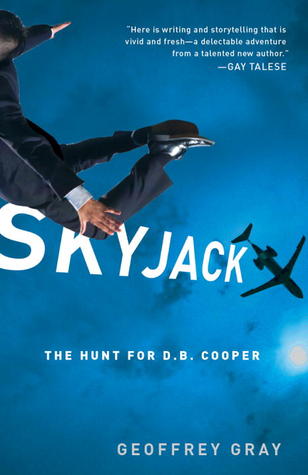
 Today, I am pleased to be able to offer two of my readers with a United States addresses a copy of Skyjack: The Hunt for D. B. Cooper
 . Just fill out the form below before the giveaway closes on October 10, 2012 at 11:59 pm CST. I haven’t read the book myself so I’ve included the information I received from the publicist below. Good luck!
Some conspiracy theories fly under the radar. Some explode in our faces, grabbing the attention of millions. Others calmly ask to speak to the airplane’s captain, extort the airline for $200,000, and then parachute to safety and anonymity somewhere over the Pacific Northwest.
In the forty-plus years since the infamous hijacking – during which no one has gotten even remotely close to figuring out the true identity or whereabouts of the man known only as DB Cooper – a lot of theories have been spun. Was the CIA involved in staging the hijacking as a means of putting pressure on legislators and airline companies to take drastic new airport security measures? What about groups like Air America or Evergreen International – alleged CIA cutouts with ties to Nixon and the White House Plumbers?
In the New York Times Bestselling account, Skyjack: The Hunt for D. B. Cooper, author Geoffrey Gray looks at the case from every possible angle. As the first journalist with access to the FBI’s confidential files on Cooper, Gray uncovers the extraordinary measures taken by the Federal government to find the hijacker (including multiple reconnaissance flights involving the SR-71 Blackbird, and extensive collaboration between the FBI and CIA on the case), and interviews hundreds of personnel involved in the original hunt. Skyjack is a book that raises just as many questions as it sets out to answer, and is a great read for any lover of cold-case crimes and cover-ups.
 Tiger Hills by Sarita Mandanna
Publisher: Pintail
Paperback Release Date: August 28, 2012
My rating: 5 of 5 stars
Publisher’s Description:
The year is 1878, the year a beautiful baby girl, Devi, is born. Her fate is intertwined with Devanna, a gifted young boy whose mother has died in tragic circumstances. The two quickly become inseparable, until Devi meets Machu the tiger killer, a hunter of great repute. It is the tangled relationship between the three that leads to a devastating tragedy—an event with unforeseen and far-reaching consequences for generations to come.
Tiger Hills is an epic novel that spans most of Devi’s lifetime. Devi, Devanna, and Machu are all layered, multi-dimensional characters. They are flawed but heartbreakingly sympathetic, each in their own way. Ms. Mandanna even spends quite a bit of time building out the secondary characters like Nanju and Appu as well. Even if I didn’t agree with an action one of the characters took, I knew exactly why they would do such a thing because the author paid so much attention to each character’s development. (I don’t want to get into specifics and spoil the story!) I especially loved Devi and her strength in a time period when it was hard for women in India to do much of anything on their own.
I also loved reading about the traditions of the time and region. I love reading Victorian novels with all of the strict etiquette that characters must operate within. I enjoyed this book for the same reason – life was very ritualized; it was just a different set of rules. Since Tiger Hills spans such a lengthy period of time, society evolves and changes. The author does a nice job of bringing in the real-life historical events that were happening and showing the reader how these events affected the families in this book and India as a whole.
I loved this book – it’s hard to believe that it’s Sarita’s Mandanna’s first novel. It was longlisted for the 2010 Man Asian Literary Prize, which is not hard to believe. I can’t wait to see what Mandanna comes out with next.
Buy this book at:
Amazon Powell’s Books
(I received a copy of this book courtesy of the publisher.)
October 2nd, 2012 in
Books |
1 Comment
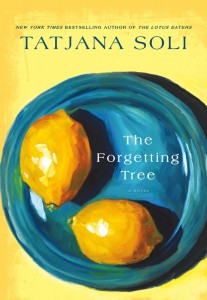 Last week, I reviewed The Forgetting Tree by Tatjana Soli. Today, I am pleased to be able to offer a copy to one of my readers with a United States or Canadian address. Just fill out the form below before the giveaway closes on October 8, 2012 at 11:59 pm CST. Good luck!
October 1st, 2012 in
Books |
1 Comment

After months of a long, drawn out and stressful legal process, the papers are signed, everything is official and I can now introduce my daughter Neve to everyone! (Neve rhymes with Bev – we chose it because we liked Neve Campbell’s name but she is not named after Neve Campbell.)
She’s cute, stubborn, spunky, independent, and sweet. In other words, she fits right in with her big brothers! She’s only lived with us since January and I already can’t remember a time when she wasn’t here. We are so, so blessed.
September 30th, 2012 in
Family,
Neve |
2 Comments
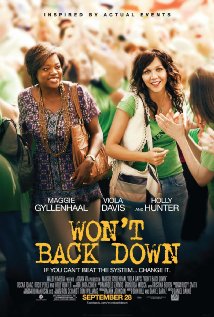
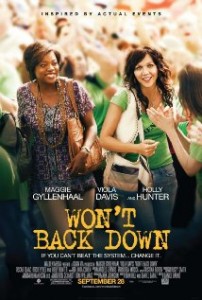 In Won’t Back Down, Jamie Fitzpatrick (Maggie Gyllenhaal) is a frustrated single mother to a dyslexic child. Her child’s teacher won’t do anything to help her daughter get the special help she needs to overcome her dyslexia and learn how to read. After a lot of persuasion, Jamie enlists the help of another teacher at the school, Nona Alberts (Viola Davis), to help her take control of the school using California’s “parent-trigger” law. With enough parent and teacher signatures, the parents can take over the school, basically turning it into a charter school.
At the beginning of the film, it states that is inspired by true events. By this, they mean that it is loosely based on what could happen if California’s parent-trigger law were used successfully. The actual school and people in this movie are fictional.
I love feel good, inspirational movies about teachers and/or parents turning kids and schools around – Stand and Deliver and The Ron Clark Story are two of my favorite examples. I didn’t get that same inspired feeling from watching Won’t Back Down. For one, the “parent-trigger” law isn’t explained very well and at times it’s unclear what the ultimate goal/plan of Jamie and Nona’s is if the school is taken over.
Also, this film has a strong anti-teachers’ union slant. Coming from a long line of educators, that is not something I can abide – especially when the representation of the teachers’ union in this movie is just not realistic. For instance, I find it very hard to believe that a real union would FORBID teachers from staying after school to help students if that’s what the teachers wanted to do. Also, having tenure does not mean that you don’t have to do your job or that you can abuse students.
At the beginning of the film, Nona is a beaten down, burned out teacher. Davis plays her almost robotically. At times I had trouble understanding her dialogue because it she muttered it so tonelessly. After her fabulous performance in The Help, my expectations of her are high and she didn’t quite meet them in this movie. Holly Hunter also gives a somewhat wooden performance as a union official. In her case, I think that she has too much Botox and it’s impeding her ability to emote. Gyllenhaal was a bright spot in this movie – her portrayal of a single mother was tough, yet optimistic and charming.
I think making an entertaining film based on a complicated legal statute is a tough job and Won’t Back Down wasn’t quite up to it. That’s not to say that I wasn’t entertained but it was hard for me to get past my issues with the plausibility of the plot as a whole.
Won’t Back Down opens in theaters tomorrow.
(I received complimentary tickets for an advance screening of this movie from a publicist.)
September 27th, 2012 in
Movie Reviews |
No Comments
 The Forgetting Tree by Tatjana Soli
Publisher: St. Martin’s Press
Release Date: September 4, 2012
My rating: 3 of 5 stars
Publisher’s Description:
When Claire Nagy marries Forster Baumsarg, the only son of prominent California citrus ranchers, she knows she’s consenting to a life of hard work, long days, and worry-fraught nights. But her love for Forster is so strong, she turns away from her literary education and embraces the life of the ranch, succumbing to its intoxicating rhythms and bounty until her love of the land becomes a part of her. Not even the tragic, senseless death of her son Joshua at kidnappers’ hands, her alienation from her two daughters, or the dissolution of her once-devoted marriage can pull her from the ranch she’s devoted her life to preserving.
But despite having survived the most terrible of tragedies, Claire is about to face her greatest struggle: an illness that threatens not only to rip her from her land but take her very life. And she’s chosen a caregiver, the inscrutable, Caribbean-born Minna, who may just be the darkest force of all.
I have mixed feelings about The Forgetting Tree. On the one hand, the prose was lush and poetic. I felt like I was in a melancholy fog right along with Claire as I was reading it. On the other hand, I could not relate to Claire or Minna at all. I think they both were mentally-ill in some way. I never found Minna to be a mysterious enigma – I found her to be crazy and mean. I couldn’t understand why Claire was taken with her – sometimes I felt like it was mostly just because Minna was black and Claire hadn’t been around too many black people in her life. That made me uncomfortable, but that is also just my interpretation of Claire and could be totally off base.
This may be one of those cases where I am too practical for a book. I just wanted Claire to fire Minna and get on with her life. I kept wondering why no one else in her family was intervening – I think it was pretty clear Claire needed some kind of mental help. My problems with the plot got in the way of my enjoyment of the beautiful writing. The descriptions were wonderfully written, I just didn’t care for a lot of what was being described. Although, I didn’t love this book, I think there are people out there who will. If you think that person could be you, come back next week when I’ll be giving away a copy to one of my readers!
 Thank you to TLC Book Tours for providing me with a copy of this book. Check out the other tour stops:
Thursday, July 5th: CBS Los Angeles – LA’s Summer Reading Guide
Tuesday, September 4th: The Book Snob
Wednesday, September 5th: Bookish Habits
Thursday, September 6th: Broken Teepee
Monday, September 10th: nomadreader
Tuesday, September 11th: My Bookshelf
Thursday, September 13th: Musings of a Bookish Kitty
Tuesday, September 18th: West Metro Mommy
Wednesday, September 19th: Suko’s Notebook
Monday, September 24th: BookNAround
Tuesday, September 25th: Silver and Grace
Wednesday, September 26th: In the Next Room
Thursday, September 27th: The 3 R’s Blog
Monday, October 1st: The Written World
Friday, October 5th: Luxury Reading
TBD: So Simply Sara
Buy this book at:
Amazon Kindle Store
 Powell’s Books
September 26th, 2012 in
Books |
3 Comments