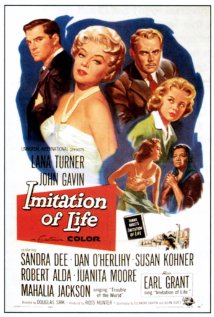
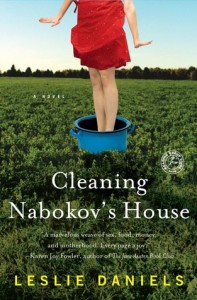
 Yesterday, I reviewed Cleaning Nabokov’s House which I highly recommend. Today, I am thrilled to be able to give away copies to three of my readers with US addresses. Just fill out the form below. This giveaway will be closed for entries at 11:59pm CST on July 17, 2012.
 Cleaning Nabokov’s House: A Novel by Leslie Daniels
My rating: 4.5 of 5 stars
Publisher’s Description:
When Barb Barrett walks out on her loveless marriage, she doesn’t realize she will lose everything: her home, her financial security, even her beloved children. Approaching forty with her life in shambles and no family or friends to turn to, Barb must now discover what it means to rely on herself in a stark new emotional landscape.
With only a questionable business plan in hand, Barb is determined to reinvent herself. She moves into a house once occupied by the literary genius Vladimir Nabokov, author of the notorious Lolita. She discovers what could be Nabokov’s last unpublished manuscript and from there begins a personal journey that is deliciously romantic, darkly comic, and wise.
Cleaning Nabokov’s House went a completely different direction than I was expecting. I thought it would be mostly about Barb finding the manuscript and trying to get it published but that was only a small part of the story. It’s about her trying to become a functional human being again after getting divorced and losing her kids. She starts an unorthodox business in the sleepy little town she lives in which was a surprise to me although now I know it’s foreshadowed in the very first sentence of the book. Throughout it all she maintains a wry sense of humor that is probably what keeps her from going completely insane.
I think one of the reasons I enjoyed this book so much is that Barb reminded me of one of my friends after her divorce. I could imagine my friend thinking and saying a lot of the things that Barb did. Barb has some really great lines. For example, after she finds out her ex-husband has a girlfriend:
I asked myself sternly, “Why shouldn’t he be happy?” I answered myself like this: “Why shouldn’t he be dead?”
The book is full of this kind of wry humor, which helps provide relief when Barb’s situation feels utterly bleak. Even though Barb is fairly socially inept and just plain weird sometimes, I found myself rooting for her on all fronts. I thoroughly enjoyed Cleaning Nabokov’s House.
Make sure to come back tomorrow – I’ll be giving away three copies of this book! (US only)
Buy this book at:
Amazon Kindle Store
 Powell’s Books
(I received a copy of this book courtesy of the publisher.)
July 9th, 2012 in
Books |
2 Comments
 Here is your surprise bonus review to wrap up Polygamy Week!
Becoming Sister Wives: The Story of an Unconventional Marriage by Kody, Meri, Janelle, Christine, and Robyn Brown
My rating: 4.5 of 5 stars
One of my not-so-secret shames is that I love TV tie-in books so when I saw that a Sister Wives book had come out, I had to get it. (Sister Wives is a reality TV show on TLC that stars Kody Brown, his four wives: Meri, Janelle, Christine and Robyn, and their seventeen children.)
Becoming Sister Wives is divided into four parts and each wife wrote her own section for each part. Part 1: Matrimony is each wife’s story of how they came to marry Kody. Part 2: Sorority is about how the wives get along with each other. Part 3: Family is about how the financial side of the marriage works and how the wives raise their children. Part 4: Celebrity is about how the wives’ extended families reacted to them being on a reality TV show and how the wives are handling the stress of press tours, etc. Kody wrote the prologue and epilogue.
Since I am a huge fan of the Sister Wives TV show, I’m happy to learn any inside information about the show and family that I can. One of the reasons I like the show so much is that for the most part everyone gets along and there isn’t too much drama or negativity. After reading this book, I know that the Brown’s are keeping a lot of the more negative things going on in their lives from the camera. The show gives the impression that the first three wives have always been best friends. However, according to the book, they actually have never gotten along that great and are friends on a surface level at most.
Although I mostly admire the Brown’s for being discrete on the show and in the book, part of me wants to know some down and dirty secrets! The wives mention fights and conflicts but are vague about details. Janelle writes about moving out several years ago when she and Meri had a really bad fight but doesn’t write anything about what the fight was about. Meri writes about how she and Kody courted someone before Janelle but broke of the engagement when things went sour. She gives no details about why. This book was only 270 pages with a pretty big font so there was definitely room for dishing dirt. I can understand why they didn’t even though I was somewhat frustrated by it.
This book goes into more of the religious reasons that they believe in plural marriage but doesn’t go all the way. I think they are probably afraid of alienating people if they explain the whole deal because it is a very male dominated thing, with the man being the only way his wives can get into heaven. Also, the Brown’s emphasize that although they are fundamentalist Mormons, they are not part of the FLDS led by Warren Jeffs. They don’t name their domination in the book but according to Wikipedia, they belong to the Apostolic United Brethren, which is fairly liberal as far as fundamentalist Mormon sects go.
Although this book is intended for those who watch Sister Wives, I think that it would also appeal to those who want to learn more about modern day polygamy. If you are a die-hard fan of the show like I am, then you need this book for sure.
Buy this book at:
Amazon Kindle Store
 Powell’s Books

Please link up any polygamy related reviews or posts – new or old! You can put your name@your blog name (title of book or post). Example: Rachel@ChaosIsAFriendofMine (Becoming Sister Wives). Thanks!
July 6th, 2012 in
Books |
2 Comments
 The 19th Wife by David Ebershoff
My rating: 4 of 5 stars
Publisher’s Description:
It is 1875, and Ann Eliza Young has recently separated from her powerful husband, Brigham Young, prophet and leader of the Mormon Church. Expelled and an outcast, Ann Eliza embarks on a crusade to end polygamy in the United States. A rich account of her family’s polygamous history is revealed, including how both she and her mother became plural wives. Yet soon after Ann Eliza’s story begins, a second exquisite narrative unfolds–a tale of murder involving a polygamist family in present-day Utah. Jordan Scott, a young man who was thrown out of his fundamentalist sect years earlier, must reenter the world that cast him aside in order to discover the truth behind his father’s death. And as Ann Eliza’s narrative intertwines with that of Jordan’s search, readers are pulled deeper into the mysteries of love, family, and faith.
I didn’t do a page count but by my estimation this book is about two-thirds Ann Eliza Young’s story and just one-third of it is the modern murder mystery. That was fine with me; I found myself much more interested in the historical part of the story. The modern-day murder mystery plot was a little thin. The characters didn’t have the depth that the ones in the historical part of the book did. However, it’s clear that Ebershoff thoroughly researched the FLDS church. The modern-day polygamist sect in this book is almost exactly like the FLDS run by Warren Jeffs.
The historical section of the book starts with Ann Eliza as a small child and goes up through her marriage and separation from Brigham Young. Ann Eliza was a great character – a very strong, opinionated woman, especially for the time in which she lived. I found myself wondering how much of her personality was a product of Ebershoff’s imagination. I’d like to read Ann Eliza’s autobiography at some point to see how the real Ann Eliza compares to the one in this book.
I think fans of historical fiction and/or polygamy books will enjoy this book.
Buy this book at:
Amazon Kindle Store
 Powell’s Books

Please link up any polygamy related reviews or posts – new or old! You can put your name@your blog name (title of book or post). Example: Rachel@ChaosIsAFriendofMine (The 19th Wife). Thanks!
July 5th, 2012 in
Books |
2 Comments
 Under the Banner of Heaven: A Story of Violent Faith by Jon Krakauer
My rating: 4 of 5 stars
In 1984, Ron and Dan Lafferty brutally murdered their younger brother Allen’s wife and baby girl saying that they were acting on orders from God. Ron and Dan are Mormon Fundamentalists, a breakaway sect that still practices polygamy and holds other unorthodox beliefs not sanctioned by the mainstream Mormon church.
In Under the Banner of Heaven, Krakauer delves into the minds of the Lafferty brothers and what led them to commit such a heinous crime. In addition, he interweaves the history of the Mormon church throughout the book, alternating between that and the Lafferty brothers and other modern day Mormon Fundamentalist’s stories.
Krakauer traces the history of how Mormon Fundamentalism came to be starting at the beginning with Joseph Smith founding the mainstream Mormon church. I really appreciated learning about the beginnings of the LDS faith and why the Fundamentalists split from the mainstream church. Having this detailed background information helped me to understand better what beliefs the Fundamentalists hold and why.
Krakauer is equally thorough in his examination of modern day Fundamentalism and the Lafferty brothers. He also discusses other contemporary Mormon Fundamentalists like Warren Jeffs and Brian David Mitchell, the man who kidnapped Elizabeth Smart.
This book is a great combination of true crime and history. It’s a wonderful primer on the history of the Mormon church and the status of Mormon Fundamentalism in today’s world.
Buy this book at:
Amazon Kindle Store
 Powell’s Books

Please link up any polygamy related reviews or posts – new or old! You can put your name@your blog name (title of book or post). Example: Rachel@ChaosIsAFriendofMine (Under the Banner of Heaven). Thanks!
July 4th, 2012 in
Books |
2 Comments
 Triumph by Carolyn Jessop
My rating: 3.5 of 5 stars
Triumph is Carolyn Jessop’s follow up to her first memoir Escape. In Escape, published in 2007, Carolyn writes her story of living in the Fundamentalist Church of Jesus Christ of Latter-Day Saints (FLDS) and how she finally escaped from it in 2003. In 2008, the FLDS’s Yearning for Zion Ranch was raided by the state of Texas. Carolyn’s ex-husband happened to be in charge of the ranch at the time. Carolyn was asked by authorities to serve as a consultant during the investigation since she was all too familiar with FLDS culture and customs. In Triumph, Carolyn recounts her role in the investigation as well as her feelings about the whole process of the raid and the children of the FLDS members being taken away and later returned to their parents.
There is actually not a lot of new information in Triumph if you have already read Escape. Carolyn probably could have written a long magazine article about her role after the raid but I can see why she would want to capitalize on the FDLS being in the news and known by many more people than when her first book came out.
I appreciated getting more of a behind the scenes perspective on why the children of the FLDS members were taken by the state from the ranch in the first place and why they were ultimately returned. I remember feeling very conflicted about that whole situation at the time that it was happening.
Even though this book rehashed a lot of what was in the first book, I still enjoyed reading it. I liked catching up with Carolyn and her children and finding out how all of them had adjusted to life outside the cult since the ending of the first book. I think if you liked the first book and felt invested in Carolyn’s journey in it, then you will like this book too.
Buy this book at:
Amazon Kindle Store
 Powell’s Books

Please link up any polygamy related reviews or posts – new or old! You can put your name@your blog name (title of book or post). Example: Rachel@ChaosIsAFriendofMine (Triumph). Thanks!
July 3rd, 2012 in
Books |
No Comments
 Escape by Carolyn Jessop
My rating: 4.5 of 5 stars
Publisher’s Description:
When she was eighteen years old, Carolyn Jessop was coerced into an arranged marriage with a total stranger: a man thirty-two years her senior. Merril Jessop already had three wives. But arranged plural marriages were an integral part of Carolyn’s heritage: She was born into and raised in the Fundamentalist Church of Jesus Christ of Latter-Day Saints (FLDS), the radical offshoot of the Mormon Church that had settled in small communities along the Arizona-Utah border. Over the next fifteen years, Carolyn had eight children and withstood her husband’s psychological abuse and the watchful eyes of his other wives who were locked in a constant battle for supremacy.
Carolyn’s every move was dictated by her husband’s whims. He decided where she lived and how her children would be treated. He controlled the money she earned as a school teacher. He chose when they had sex; Carolyn could only refuse—at her peril. For in the FLDS, a wife’s compliance with her husband determined how much status both she and her children held in the family. Carolyn was miserable for years and wanted out, but she knew that if she tried to leave and got caught, her children would be taken away from her. No woman in the country had ever escaped from the FLDS and managed to get her children out, too. But in 2003, Carolyn chose freedom over fear and fled her home with her eight children. She had $20 to her name.
Escape exposes a world tantamount to a prison camp, created by religious fanatics who, in the name of God, deprive their followers the right to make choices, force women to be totally subservient to men, and brainwash children in church-run schools. Against this background, Carolyn Jessop’s flight takes on an extraordinary, inspiring power. Not only did she manage a daring escape from a brutal environment, she became the first woman ever granted full custody of her children in a contested suit involving the FLDS. And in 2006, her reports to the Utah attorney general on church abuses formed a crucial part of the case that led to the arrest of their notorious leader, Warren Jeffs.
I really liked the straightforward manner in which Carolyn told her story. She was able to recount the horrible things she went through as the wife of Merril Jessop without a lot of anger coming through. That’s not to say she doesn’t have anger but she didn’t let it cloud the story she was trying to tell.
I appreciated how she repeatedly pointed out that her husband, Warren Jeffs, and their ilk were not following the principle of polygamy correctly. She gives examples of other polygamist relationships in her community in which the husband and wives were happy. (That is before Jeffs came to power. Once he was in charge, no one was really happy.) When she recalls her grandmother’s explanation to her of the spirituality behind the principal of polygamy, it actually seems to make sense. (As much sense as any religion makes to a person who is not a part of it.)
This book was published before the raid on Warren Jeffs’ Yearning for Zion ranch in 2008 but it does explain how Jeffs rose to power in the FLDS church and why he had such a hold on his followers. There are other denominations besides the FLDS that practice polygamy and may not be as cult-like as the FLDS, which I think is important to keep in mind. I really enjoyed reading Carolyn’s story – she is a strong, intelligent woman and that came through in her story.
Buy this book at:
Amazon Kindle Store
 Powell’s Books

Please link up any polygamy related reviews or posts – new or old! You can put your name@your blog name (title of book or post). Example: Rachel@ChaosIsAFriendofMine (Escape). Thanks!
July 2nd, 2012 in
Books |
2 Comments
 This week is Polygamy Week at Chaos Is a Friend of Mine! I’ll have a place to link up your reviews about books that are related to polygamy on all my reviews this week. Feel free to link up either a new review or one from your archives.
In other non-bookish news, I’ve decided to go vegan this week as an experiment to see if it helps heal my Crohn’s disease. It’s a good time because my boys are at their grandparents this week so there is no one to here to bitch about me cooking new recipes. I’m dusting off my running blog to keep track of what I eat and how it makes me feel. I’ll also post links to the recipes I make this week there.
It’s hard to believe that my sweet baby boy turned six years old yesterday.

He got to plan how we spent the day. We started off with opening presents at 7am – he was very specific about the time. Then we had a breakfast of biscuits and gravy made by Daddy and donuts. After that, swimming lessons and then back home to play with his birthday present – an Xbox 360 with Kinnect. I picked up lunch at McDonald’s for everyone and then we went to the movie theater to see Madagascar 3. We came home to play more Xbox and then went to Burger King to eat dinner and play in their play area. The boys were supposed to have a T-ball game after dinner but thankfully it was canceled due to the 107 degree heat. Then home for more Xbox. He was so into the Xbox that he didn’t even want to stop to have his birthday cupcakes so we’re going to have them today. Tonight is his birthday party at Chuck E Cheese. Then I’m going to need a serious detox from all this horrible birthday food!
June 29th, 2012 in
Family,
West |
No Comments
Yesterday I wrote about my impressions of the original 1934 version of the film Imitation of Life. Today I’m going to look at the 1959 remake of that film.
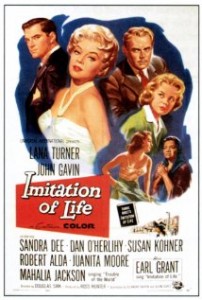 The remake is quite different from the original in several ways. Bea’s character is now named Lora (Lana Turner) and is an aspiring actress in New York City. She meets Delilah’s character, now named Annie (Juanita Moore), at the beach on Coney Island. Annie and her daughter Sarah Jane have recently become homeless and Lora agrees to take them in just for the night. Lora is a single mother supporting her daughter Susie and she can’t afford to support Annie and Sarah Jane too. Annie gets a job washing shirts and she and her daughter end up staying. Eventually, Lora becomes a successful Broadway actress and is very wealthy. Annie’s role in Lora’s success is that she takes care of Susie while Lora is working. Lora works a lot so Annie is more of a mother to Susie than Lora is in most ways.
Lora’s romance with Steve Archer (John Gavin) is fraught with conflict in this movie. He can only be with her if she prioritizes him over her work and apparently that means not working at all. He’s a good guy though; it’s clear that this expectation is not unreasonable. It’s Lora who is being unreasonable wanting to work when there is a perfectly good man wanting to take care of her. I wasn’t expecting to find such a sexist subplot – the 1930s version portrayed women in a way better and stronger light!
Sarah Jane’s struggle with being a light-skinned black person has a bigger part in this movie than Peola’s struggle in the original. I was disappointed that they did not cast a black person to play Sarah Jane. Susan Kohner did do a fabulous job playing Sarah Jane though and was nominated for both an Academy Award and Golden Globe for Best Supporting Actress for the role. Sarah Jane is even more of a “tragic mulatto” in this movie and has quite a few dramatic scenes in which she talks about why she wants to be white.
This movie address the issues of race in a more direct way than the original which I’m sure is a product of the time in which it was made. When Lora suggests that Annie talk to Sarah Jane about not trying to pass as white, Annie says, “How do you explain to your child that she was born to be hurt?” Like Delilah in the original movie, Annie wants a big funeral when she dies. She tells Lora to please invite all of Annie’s friends. Lora looks surprised and tells Annie that she didn’t know Annie had any friends besides her – very telling of the one-sided nature of their relationship.
Another difference between the two movies that I must note is the heightened drama in the remake. Lana Turner chews the scenery every chance she gets and the score is very heavy handed. The melodramatic background music makes sure that the viewer is not confused when something VERY DRAMATIC is happening.
This movie has all kinds of interesting movie star connections. Alan Alda’s dad, Robert Alda, plays an agent. Troy Donahue, who was just starting out, has a small part as a real jerk – he was not dreamy at all in this movie. And Susan Kohler’s son is Chris Weitz, the director of The Twilight Saga: New Moon.
It was interesting to watch the two versions of Imitation of Life back to back and see how much (and how little) relationships between black people and white people changed over the twenty-five years between the two movies.
Buy this movie at:
Amazon Instant Video
June 28th, 2012 in
Movie Reviews |
1 Comment
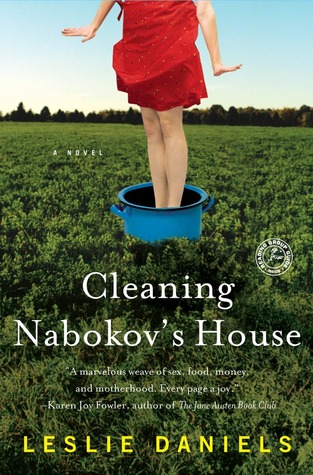 Yesterday, I reviewed Cleaning Nabokov’s House which I highly recommend. Today, I am thrilled to be able to give away copies to three of my readers with US addresses. Just fill out the form below. This giveaway will be closed for entries at 11:59pm CST on July 17, 2012.